I actually talked about this a little bit in the entries on pH in February, 2018. But maybe something a little more comprehensive or at least just addressing soil sampling should be added. Testing the soil will get you much more information than just pH. You will get nitrogen (N), phosphorous (P), and potassium (K) information on the garden. N, P, and K are the chemical symbols for these nutrients. They are also called macro nutrients. You will also get parts per million, ppm, on other elements your crops might need. The other elements are called micro-nutrients and trace elements. You also get the amount of organic matter that is in your soil. The organic matter helps to keep nutrients in a state that you plants can use and also increases the holding capacity of the soil. The holding capacity refers to both nutrients and water.
The N, P, and K are what most fertilizers try to handle. Some also contain some micro-nutrients and trace elements but that is not their purpose. You could just put fertilizer on your garden without getting it tested. Generally you will want fertilizer that has "low" nitrogen content and higher phosphorus and potassium. Nitrogen helps plants make green stuff like foliage. The phosphorus and potassium help plants to "fruit". It the garden we usually want fruit and not foliage so less emphasis on the nitrogen.
To find out what your soil needs, you get it tested. The testing starts with obtaining a soil sample. If you have a relatively small garden take a scope of soil from 3 or 4 areas in the garden and put them in a clean bucket. Mix the samples together thoroughly. Once this is complete take about a cup of the mixed up soil and put it in a plastic bag. Label the bag with your name and address and the type of testing you would like done to it. The bag labels are a precaution in case it get separated from the forms you will submit with it. Fill out the appropriate forms for the test facility. If you have a garden larger than a 1000 square feet you might consider dividing up into areas and having each area tested.
There are many test facilities but only a few to testing appropriate for Alaska's soils. The soils we have are are kind of unique because of the combination of volcanic ash and glacial silt. The cold temperatures have an effect on the soil as well. I send my soils to Brookside Laboratories in Ohio. You can check out the test information on the Alaska CES site. The site lists other labs for soil analysis and the types of tests necessary for Alaska soils.
Once you get your results in email. I would refer to an article like this one to understand all of the numbers. It will take a little time and study to work it all out but I'm sure you will be able to do it. You can always go to your local horticultural person to get some help. They are really busy in the spring so be patient but be persistent.
Now that you are armed with the information you need you can pick up fertilizer, whether organic or not, and help your garden produce the best vegetables you can. Be sure to plant at least one row for a local food pantry or soup kitchen. Many garden supply businesses give plants or seeds if you tell them that is what you are going to do with it.
May your harvest be bountiful and have a great time in the garden.
Tuesday, March 28, 2023

Wednesday, February 1, 2023
Winter in the Garden II
January 2023 is now history. My brother used to live in southeastern Wisconsin and at the end of January would always have a party to celebrate the "death" of January. I didn't do that but the event we had at church on the 28th sort of commemorates that party. We planted petunias and lobelia. We anxiously await the germination of these seeds.
Gardening season has begun. The day are getting longer now by 5+ minutes each. That means we gain almost an hour of daylight every 10 days. Indeed spring is just around the corner. This month we will put leeks and onions in pots with some soil. By the middle of March there will be greens plants on tables and racks in the narthex. Each month from now through the middle of May there will be new plants springing to life. By the middle of May they will be moving to the garden. I look forward to planting once again inside the garden fence and hopefully in the completed greenhouse.
God’s peace be with you all.
Wednesday, December 28, 2022
Asleep in the Snow
Here we are nearly in 2023. When I was a kid I never thought i would ever be living in the 21st century. Here we are nearly in 2023. When I was a kid I certainly never thought I would ever be this old and living in the 21st century. Well I made it and am certainly glad the Lord has put me on this earth for all of those years. Hopefully, I will be able to be here for many more years to come.
The garden behind the church is sleeping now. Putting together the energy to bring forth a bumper crop of veggies for the summer of 2023. While the garden has been sleeping the gardener has been busy. The seeds are all selected for 2023. Some will go into the “ground” as early as January 28th of 2023. That is the first planting for all of you curious people. We will plant petunias and lobelia that day.
These will go in the baskets we hang on the south side of the fence. We will plant two trays of petunias and two of lobelia. The petunias will be a mix of red, white, and blue. The lobelia will be blue and purple. I always look forward to putting the first seeds in the ground. It will be exciting for the congregation to watch the first planting begin to grow. About mid March, maybe earlier, we will transplant them into “larger” quarters and there they will await the move to the outside in the middle of May.
Keep an eye out for those first green shoots in the narthex in February. Be safe and may the Lord watch over you each and every day.
Saturday, January 22, 2022
How Much Seed Do I Need?
How much seed do you need to plant a 10 foot row or a 100 foot row for that matter? I had no idea, people have really worked this out. Please don't laugh too hard, I was new at this. At least one seed catalog I received this year has that information. I'm sure most of the others do as well. I had just never looked for the information. In the 2021 catalog from Johnny's Selected Seeds there is a chart on page four.
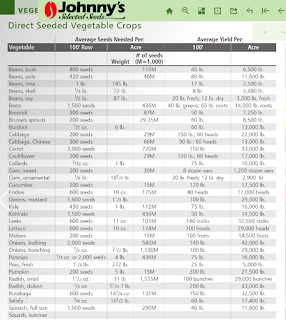 You can call the seed companies and they will be ahppy to tell you especially if you order from them. There are a number of web sites that have the information you can use your favorite search engine to find different ones if you like. You will need to be careful though as a lot of the charts you find on the web are for farmers and they only talk about seeds per acre. Seeds per 100 foot row are easy to break down into smaller units, however, seeds per acre is much tougher. I was surprised by the number of seeds needed. The chart at the right comes from Johnny's Selected Seeds catalog.
Here are just a few examples of seeding requirements for a 100 foot row. It takes 800 beans to seed a 100 foot row, 1500 beet seeds, 3000 carrot seeds (sounds like a lot), 1.25 pounds of peas, 1.5 ounces of radish seed and a third of a ounce of turnip seeds. Turnip seeds are really small and light. Planting will be so much easier this spring. Or I should say knowing how much seed to purchase will be easier.
Most of the sites give the information and I think assume that you have a planter and are not doing it by hand. Obviously they are also set up for use in the lower 48 states.
Many of the seeding suggestions just will not fly in Alaska for planting in an outdoor garden. Things like squash will never mature if you direct seed them. The soil is way too cool for them to germinate unless maybe if you put clear visqueen over the row. That being said, you should be willing to experiment with "marginal" species. You might live in a micro-climate within our zone 4 area. Yup, most of Anchorage is classified as zone 4b. But be careful, there are places in town, especially on the east side that are probably lower.
If you are going to try to grow fruit trees, yes they grow here, be sure they are grafted to root stock that is hardy to zone 3. Pears will grow just fine when grafted to crab apple root stock. Be sure to find out what the root stock is before you buy or plant.
You can call the seed companies and they will be ahppy to tell you especially if you order from them. There are a number of web sites that have the information you can use your favorite search engine to find different ones if you like. You will need to be careful though as a lot of the charts you find on the web are for farmers and they only talk about seeds per acre. Seeds per 100 foot row are easy to break down into smaller units, however, seeds per acre is much tougher. I was surprised by the number of seeds needed. The chart at the right comes from Johnny's Selected Seeds catalog.Here are just a few examples of seeding requirements for a 100 foot row. It takes 800 beans to seed a 100 foot row, 1500 beet seeds, 3000 carrot seeds (sounds like a lot), 1.25 pounds of peas, 1.5 ounces of radish seed and a third of a ounce of turnip seeds. Turnip seeds are really small and light. Planting will be so much easier this spring. Or I should say knowing how much seed to purchase will be easier.
Most of the sites give the information and I think assume that you have a planter and are not doing it by hand. Obviously they are also set up for use in the lower 48 states.
Many of the seeding suggestions just will not fly in Alaska for planting in an outdoor garden. Things like squash will never mature if you direct seed them. The soil is way too cool for them to germinate unless maybe if you put clear visqueen over the row. That being said, you should be willing to experiment with "marginal" species. You might live in a micro-climate within our zone 4 area. Yup, most of Anchorage is classified as zone 4b. But be careful, there are places in town, especially on the east side that are probably lower.
If you are going to try to grow fruit trees, yes they grow here, be sure they are grafted to root stock that is hardy to zone 3. Pears will grow just fine when grafted to crab apple root stock. Be sure to find out what the root stock is before you buy or plant.
Monday, January 17, 2022
To Direct Seed or Not?
Should I start the seeds indoors or direct seed them when the temperatures warm up? This question has posed a conundrum for gardeners forever. There are some things that you must direct seed because they do not transplant well at all. Generally crops with long taproots that are the crop like carrots and parsnips should be direct seeded.
If you are going to grow peppers you will need to start them inside or in a heated greenhouse by the beginning of February or at least the first of March. You can transplant them into covered beds and they will do fine outside after the danger of frost is history. I usually grow three or four types of chiles. Some years they do better than other depending on the weather.


Carrots, these orange beauties do not transplant well. If you try, you will get really gnarly roots. For some reason transplanted carrots just don't do well. If you get really strange shaped roots it's usually because they have been disturbed during growth somewhere along the line. Most people think the "unique" shaped roots are because of rocky ground or some such but usually because of cultivation or hand weeding the roots were messed with and go bonkers. So direct seed carrots and try not to disturb the roots.
Most types of beans should be put directly in the ground. Beans will germinate faster if you soak the seeds in water about 24 hours before you plant. They don't like to have their roots disturbed. If you must transplant them start them in individual pots and try to disturb the roots as little as possible. Bush beans and "pole" beans fall into this category.
Squash is sensitive, too. I have tried many different things to make them grow better. It turns out you will get the earliest harvest by starting the seeds in small pots first. Usually two to three weeks before you want them to go into the ground. So no earlier than the first week of May, When you transplant once again try to disturb the roots as little as possible. There is another way as well. Put your say zucchini seeds between two wet paper towels. Cover them. Put them in a plastic bag or wrap them in cellophane. Then leave them in a warm place for a week. The seeds will sprout. Once sprouted you can plant them in the soil and they will do fine. The sprouted seeds will be behind the transplants about two weeks. After that you won't be able to tell which were which.
Just about all of the brassicas can be direct seeded. Again things like cabbage, cauliflower, broccoli will harvest a little later. This type of crop transplants very well. They can be put in the ground before the danger of a light frost has past. They are tough. They can take a beating. Just remember those little plants grow to be very large. Plant them at least 24" apart.
No need to start peas. You can put them in the ground as soon as you can work the soil. They will germinate faster if you soak them in water for a day before you plant. Make sure you have something for them to "climb" on. It makes harvesting much easier.
Most everything else that can be direct seeded should go in the ground by the middle of May. There is always an exception and in this case it's lettuce. You need to direct seed this crop but not until after the danger of frost is well past. In Anchorage and south central Alaska that usually after Memorial Day.
Have fun! See you in the garden!
Monday, December 13, 2021
When to Order Seeds?
 |
| Radishes |
I bought my 2022 seeds in November of 2021 from Johnny's Selected Seeds. One item I wanted won't be available until March of 2022. I ordered the rest and will get that one variety as soon as it's available. Fortunately, that particular seed doesn't have to be started in January or even April. It can be direct seeded so no big deal. But for the 2021 season I didn't order until January of 2021 and some of the varieties I wanted had already been sold out. I substituted for other varieties but I was not happy.
 |
| Green Onions |
Research the varieties you want to grow. Make a list. Go to several websites. Do the "baskets" and check on the shipping. Talk to your gardening friends. You can save a lot of money on seeds by shopping around. It just takes time. In the winter, what else is there to do. Just kidding. This is a shopping trip that you can do from you kitchen table.
Lastly, be wary of some vendors on Amazon. While Amazon stands behind their products sometimes the vendors don't send you the things you ordered. If you put cabbage, turnip, and kohlrabi seeds next to each other you won't be able to tell them apart. Seed sellers can't either. Use a trusted source. Also if you order direct from the vendor on their own website you may get a better deal.
Have fun! See you in the garden!
Sunday, November 28, 2021
The 2022 Season has Begun
I know it seems early to be talking about the 2022 gardening season. Yet I have been studying seed catalogs for about 6 weeks. Have been deciding what to discontinue and what new things we should be the next experiment. Most of the last week has had single digit highs and below zero lows and I ordered seeds. Just about everything is on it's way for the new season. We will begin planting at the end of January and that's not very far away. Looking forward to getting my hands in the dirt again. The tentative schedule for 2022 plantings follows.
Jan 29 Petunias, lobelia, leeks, and onions
Feb 29 Peppers
Mar 19 Repot things planted on Jan 29.
April 9 Brassicas
April 30 Zukes
May 1 Begin hardening off, weather permitting
May 1-8 Till, potatoes and peas in the ground
May 15-21 Brassicas in the garden, peppers in the beds
May 22-28 Zukes in the ground and rest of the seeds planted.
May 29 Weeding begins
June 24 Harvest radishes and bok choi
Hopefully all will be well in 2022. Thanks for reading and stay safe.
Wednesday, November 24, 2021
Award Winning Garden
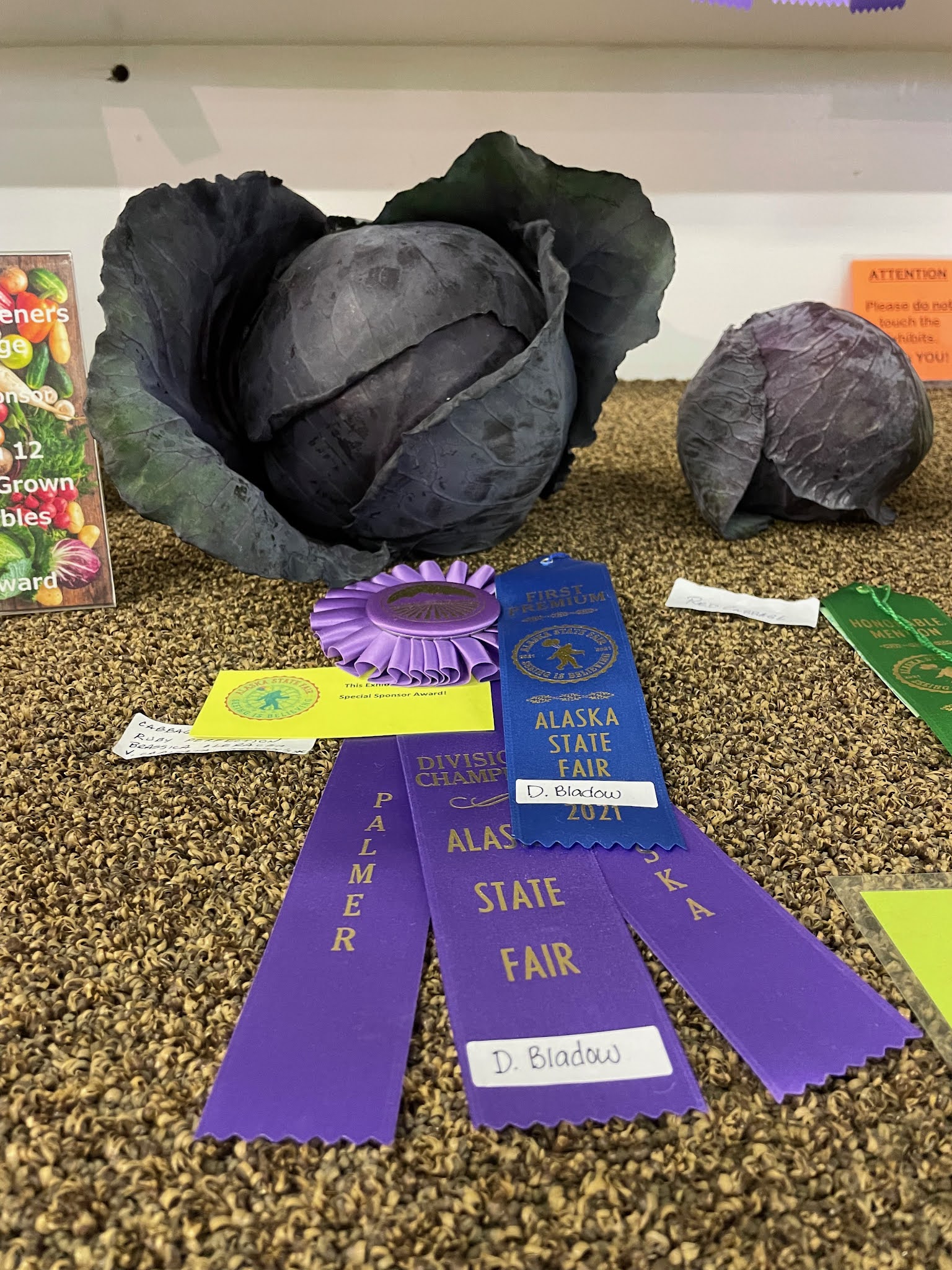
In 2019 and 2021 I entered crops in the Alaska State Fair. In 2019 the crops entered did quite well with firsts, a second, and thirds. There was no fair in 2020 because of COVID-19. In 2021 I also entered crops from the garden. This year there was a division champion, many firsts, two seconds, and an honorable mention. In the picture below the white ribbons and left are from 2019. The ones to the right are from 2021. The exquisite quilt was a gift from Donna Dooley who lives down the street from Bonnie and I. I thought it would be a great medium to display the awards. As you can see I will have to find a different way to display awards from next year, if there are any.
 | |
| 2019 and 2021 Awards |
 |
| "Red" Cabbage |
that the awards show people receiving the produce that the food is excellent quality. Often food pantries and other places that feed those in need get the left overs, the expired or nearly expired foods. The garden provides fresh, excellent quality, fantastic tasting food for those served. Though I haven't talked with many I know the quality and freshness of the food is greatly appreciated by our clientele. The quantity and quality allows the food pantry and others to use at least some money in other areas of need than having to purchase fresh food. The garden also provides foods that are not usually available in pantries. Leeks, onions, and carrots are seldom seen in food pantries because even low quality produce of these varieties bring premium prices in the grocery stores and farmer's markets.
 |
| Habaneros |
Prior to 2019 I was reluctant to enter anything in the Alaska State Fair because of my lack of experience and I did not think the produce was award worthy. I was blown away in 2019 when I won awards. I was amazed at being awarded division champion in 2021 for a lovely "red" cabbage. I am aware that the exhibits at the state fair are beauty contests. However, in most cases the
 |
| Leeks |
Tuesday, November 23, 2021
2021 The Year of COVID-19
 | |
| Potato Harvest |
 |
| Onion Thinnings |
 |
| "Red" Cabbage |
 |
| Radishes |
 |
| Turnips |
 |
| Zukes |
We had a couple of turnips this year that were nearly 5 pounds each. They were not woody at all and tasted excellent. There were also a few carrots that were nearly a pound each. Many of the potatoes were more than a pound and a half. You have to love the long summer days in Anchorage. The plants just keep making that sugar. All day and nearly all night making things sweeter and sweeter. That's one of the big reasons our produce is so tasty.
 |
| Carrots |
2020 Over?
This is a post I wrote at the season end in 2020 and never published. So will do it now and put a few more out about 2021. Sorry for be so neglectful of this blog. I will try to do better in the future. If you are interested in helping with this blog please let me know.
As 2020 comes to an end I have been once again neglecting this blog. Seems July was only yesterday but alas it was four months ago. The garden did flourish this year. The goal of 4500 pounds did not happen but with nearly 3800 at the Lutheran Social Services Food Pantry I would call the season a success. Next year hopefully we will do better. Since the gardens inception in 2015 we have grown more than 8.4 tons (16,800+ pounds) of produce. With a little luck we can go over 10 tons in 2021.
The biggest crop for the year was turnips coming in at more than 1100 pounds. The biggest surprise of the year was dill. That harvest was nearly 26 pounds, that's a lot of dill. We did have some vandalism this year that effected the harvest. With the location I guess it's to be expected but is was still distressing.
There won't be any fava beans planted in 2021. They have not be very successful for 2 years now so they are going to go by the wayside. Next season pole beans will be tried in there place. We will have to sacrifice some of the pea space for the beans. We will see if the substitute works out okay. I'm also going to put in a horse radish patch. Haven't decided where to put it yet but it will be enclosed so the roots don't escape into the rest of the garden. I will be changing the cultivars of carrots and beets in 2021. This change is based on results from some tests done by the Cooperative Extension Service in 2019. The change could increase the yield by as much as 20% with no sacrifice and quality or taste.
I'm also thinking about building two more elevated boxes. The elevated boxes are much easier to maintain than the main garden so the increment of work is not appreciable. They work really well for some of the crops and having 8 will allow for more "rotation" of the things that get grown in them. The onions do much better in the boxes than being direct seeded in the garden. The soil is probably too cold for good germination. The boxes are also every easy to make into a mini-greenhouse. All you have to do is put some hoops on and cover with plastic.
Tuesday, July 28, 2020
July at an end
It's the end of July. The days are getting shorter, though we really don't notice yet. The weather has been very good for gardeners. There has been lots of sun and pretty much normal rainfall for July. Still have to water but certainly not as much as last year. We finally have the weeds "under control" and can start focusing on increasing our crop.
 |
| Turnips |
Turns out, as usual, the turnips are doing quite well. The harvest has been more than 850 pounds to date. The tur
nip
patch is now empty. I will fertilize the area again and plant a second
crop. Last year was the first time I did this but I didn't fertilize
again. The turnips were small but plentiful. Hopefully with the
additional fertilizer they will do better. If the frost holds off till
the middle of September we should do well. The harvest so far is much
more than the two crops last year.
I changed the variety of broccoli (arcadia) and the heads were much, much better. However there doesn't seem to be many subsequent smaller heads. Will have to w
ait and see with the broccoli. I could certainly have more food if I just planted more cabbage or sprouts. Not sure of the best solution. Will kick it around for a while and see what shakes out.
 |
| Washing Station |
 |
| Zucchini |
We did a little experiment with the zucchini this year. I had about 25 seeds left over after the initial potting up and starting the plants. The week we put the squash plants in the ground I germinated the "extra" seeds between moist paper towels in a plastic bag. Once they had a root we took them out and put them in the ground. They did indeed grow just fine. We are harvesting summer squash from those plants just like we are from the seedlings we planted. Now you cannot tell the difference between the "regular starts" and the germinated seeds. The zukes so far is just shy of 200 pounds.
The only thing in the garden this year that seems to be having difficulty is the beets. They are sparse and slow. Same thing happened last year. I will have to do some study and try to figure out what the problem may be. Won't certainly have a resolution to report on until next summer about this time. But I will definitely write it up next year.
All is well with the garden. The Lord has definitely blessed us this year. Enjoy the rest of the summer.
Sunday, June 28, 2020
Really, June Is Nearly Over
 |
| Turnips |
It doesn't seem possible that June is nearly over. Where has the time gone? An update is in order. The kale and collards have been brought into plain sight. They were so overgrown by grass and weeds it was difficult to tell things were really planted in the space. The cabbage is doing very well. The Brussels sprout were nearly done in by some neighbors escaped live stock (partridge). But they are growing and we will see what happens. The turnips should be ready in two or three weeks. The beans are up but don't look great. The leeks and chard are doing very well. The peppers are in varying stages of maturity but that's the way they always seem to be. Actually everything is doing pretty well just slower than I would like, but that's the way it always works out.
 |
| Kale & Collards |
In the picture above are the turnips after doing most of the weeding. To the right are where the kale and collards live. The picture to the right shows what the kale and collards looked like after the weeding was done. There is quite a difference.
We will have the first radishes tomorrow, June 29. With a little luck we will harvest the first zucchini this coming weeks as well. We will also harvest the first pok choi at the end of the week.
Oh, and the seed potatoes I got this year were quite small but they seem to be doing just fine. They may have been planted a little close together but that will just mean smaller potatoes at harvest time.
Since we are harvesting the radishes we will also be planting more. Same with the pok choi.
Tuesday, June 9, 2020
The Apple Orchard
 |
| Orchard Planting |
There are two trees inside the garden fence (State Fair and Carroll). I grafted them onto hardy root stock the spring of 2017. They were about 18 inches tall when I planted them. One was pulled out by vandals late in October of 2017. I put it back in the ground but the ground was mostly frozen. This tree did not survive. The lonely survivor will bear some fruit in 7 or 8 years. The survivor is about three feet tall now.
 |
| Blossoms Closeup |
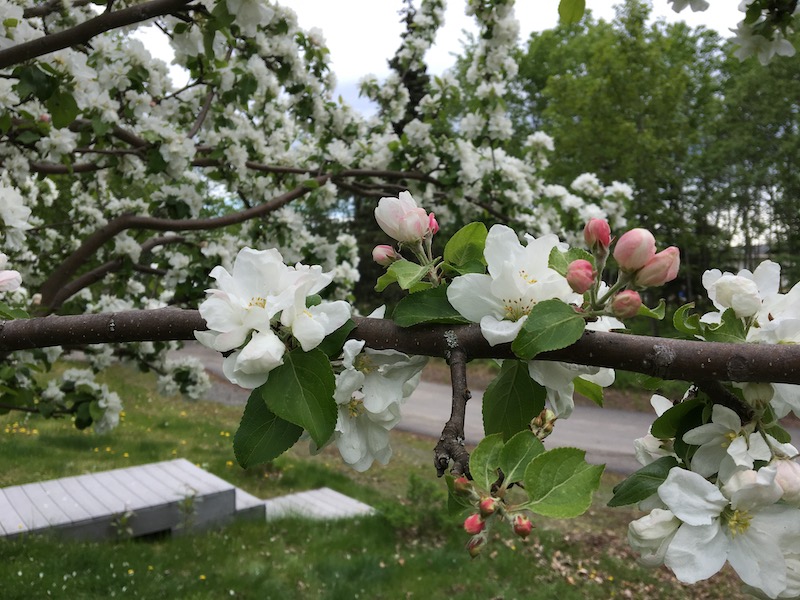
Five trees north of the garden (Norland, Zestar, and Prairie Magic) will produce a harvest in 3 to 4 years. If they all survive and produce well we could be harvesting 300 to 400 pounds of apples in the coming years. Three of the "orchard" trees did produce some apples in 2018. The Prairie Magic has very tasty fruit. The trees had a bad year in 2019. June and July were very dry. I did not water the trees and they suffered from the lack of water. The only apples on them were very hard and very small.
 |
| Parsonage Apple Tree 2018 |
The orchard is fenced the same as the garden to keep the hungry moose out in the winter. They don't seem to bother the trees in the summer time. The fence is 7.5 ft. tall so should keep them out.
As expected only one of the trees has any blossoms in 2020. The Prairie Magic has blossoms but it's too early to tell if there will be any fruit. Hope springs eternal. The blossoms on the parsonage trees are sparse this year as well. Hopefully we will still get some apples from the trees. If not the goal of 4500 lbs for 2020 will be very difficult to reach.
Sometime in the future I may try my hand at making cider. There should be plenty of apples to press. This is another investment in equipment so only time will tell.
Thursday, June 4, 2020
June Already?
Where does the time go. I have been going to do an update and all of a sudden it's June. All is well at the garden. The brassicas are in the ground and doing well. The turnips and peas are up. Green beans just showed yesterday. But the first thing up this year was the Swiss chard. No onions or carrots up yet but I am hopeful. Planted 70+ zucchini this year and they seem to be doing fine. At least they all appear to have new growth which is a good indication they survived the transplant. The peppers are doing well in their mini green houses. Planted two varieties of radish this year. One was the standby, rover, from Johnny's and a wasabi radish that was gifted to me by a friend. It's green and should be interesting. Still have to finish planting the potatoes and the fava beans are yet to go in the ground. With luck all should be done by Sunday.
I did a little experiment as well this year. I had some zucchini seeds left over so I put them between a couple of wet paper towels and put them in a plastic bag. I knew they would sprout. My wife put the sprouted seeds in the garden. Will see what happens with them.
 |
| Wash Station |
I modified a work bench that was donated. Shorted the height. Flipped the boards on the top and added a screen that we have used to wash the veggies. I also installed a slanted "runway" to channel the wash water away from feet and legs. Hope it works better than the two tables.
Shooting for 4500 pounds this year. Hope we can do it.
Monday, May 4, 2020
Alaska Master Gardeners Anchorage
This is a very special thank you to the Alaska Master Gardeners Anchorage. They have been very generous with a grant of $500 for the Harvest of Hope Memorial Garden. This grant along with other contributions will not only pay for the operation and maintenance of the garden this year but will go along way in beginning a new project. The project is to build a hoop house between the north edge of the garden and the orchard.
 A hoop house will allow us to grow crops we would normally be able to plant. These "buildings" extend the season so we may begin in April and possibly go into November before we have to put it to bed for the winter. I look forward to beginning construction this summer. With a completion in early 2021. Will keep you all posted on the progress as we move it along.
A special thank you for all the gifts we have received this year.
 A hoop house will allow us to grow crops we would normally be able to plant. These "buildings" extend the season so we may begin in April and possibly go into November before we have to put it to bed for the winter. I look forward to beginning construction this summer. With a completion in early 2021. Will keep you all posted on the progress as we move it along.
 A special thank you for all the gifts we have received this year.
Sunday, April 26, 2020
When To Plant
 |
| Early April |
 |
| Seed Packet Front |
 | |
| April 24 |
By the 20th of May all of your seeds should be in the ground, all of mine are. The ground will probably be below 50° yet but they will grow. If you want to be absolutely safe put in your summer squash Memorial Day weekend. I would chance a week earlier and be prepared to replant if necessary. Crops like leaf lettuce and radishes do best in the cool spring weather. But be prepared to plant subsequent crops as you harvest the first plantings. Radishes and leaf lettuce mature in about 30 days.
 |
| Seed Packet Back |
Planting is the time of anticipation and anxiety. I can't wait 'til it comes up. Then there is the other side of the coin, I hope it comes up. You will experience both. Have fun planting.
Don't throw away the seed packet when you are done planting. The back of the packet has a lot of useful information for later use.
Friday, April 17, 2020
Let Yarducopia Use Some Space
 You do have an "urban" lot that you would like to mow less often or
maybe not at all. There is an organization that can help you with
that. Let's say you would like to provide produce for some organization like Lutheran Social Services Food Pantry, the Gospel Rescue Mission, or maybe Bean's Cafe. You don't have the time. You suspect you don't have the talent to do a garden from start to finish. Yarducopia uses your property to help people learn organic gardening practices and raise food. The food is split between the people doing the gardening, the home owner, and a nonprofit organization of the homeowner's choice. This is a method to use your property for gardening, help someone else learn gardening, share your bounty with others and have wonderful fresh produce grown on your property to enjoy during the harvest season.
You do have an "urban" lot that you would like to mow less often or
maybe not at all. There is an organization that can help you with
that. Let's say you would like to provide produce for some organization like Lutheran Social Services Food Pantry, the Gospel Rescue Mission, or maybe Bean's Cafe. You don't have the time. You suspect you don't have the talent to do a garden from start to finish. Yarducopia uses your property to help people learn organic gardening practices and raise food. The food is split between the people doing the gardening, the home owner, and a nonprofit organization of the homeowner's choice. This is a method to use your property for gardening, help someone else learn gardening, share your bounty with others and have wonderful fresh produce grown on your property to enjoy during the harvest season.The organization is now taking signups now for the next planting season. Check them out. You might just strike gold right in your own yard.
Sunday, April 5, 2020
A Special Thank You
I wish to thank ELCA World Hunger for their Domestic Hunger Grants. I applied last week for a $500 grant for the garden. They were kind enough to approve the grant. They also asked me to put up a fund raiser to see if I could get a match for the $500.
Thank you to everyone who has made or will be making a donation. As of this morning the campaign for the garden has raised $750 in just a single day. Many as well have asked where they could mail a check. If you are interested in sending a check the address is on the right hand margin of this blog post.
 If you wish to pay by credit card click here. 100% of the funds will go to the garden. You can do this through April 15. After that please send a check to the address on the right.
Thanks to all of you for your monetary donations, your time, and your talents. All are very useful to the garden each day of the year.
Friday, April 3, 2020
April, In Like a Lion
 |
| Fire Pit |
 |
| Bare Ground |
Two days this past week I burned a bunch of brush that had been stacked up for a couple of summers. Some of the pile is still buried in the snow but probably 85% of it is gone, up in smoke so to speak. I will probably do some more of that next week as well. There are multiple brush piles. Will also be washing some more seed starting equipment next week. When the seeds come will have to plant them into something.
I'm going to try a new variety of peppers this year as well. They are called Aji Rico. They were developed in Peru. I picked this variety because it's supposed to have a 50-55 day maturity from the time of transplant. If things work well at home I might try to plant it in the main garden next year. They haven't arrived yet and will be trying to grow them in the house this summer and next fall. I will keep you apprised of the progress or lack of progress in this space.
That's all for now. Stay safe!
Monday, March 23, 2020
Celebrate the Small Victories
 |
| Leeks |
As you might recall we planted chili peppers and leeks before we left. The leeks are doing fine but the chili were eaten to the dirt by some critter, probably a shrew. They are resourceful little buggers. Once the quarantine is complete I will set some traps and see if I can get it or them.
 |
| Pepper Redo |
On the bright side, I did order the seeds for the garden today. Hopefully they will arrive in time to get the broccoli and cabbage started the middle of April. I will be working on get the stuff ready while locked up. Plan to start the zucchini about the 1st of May. That worked very well last year.
Stay well, more later.
Subscribe to:
Posts (Atom)