The garden is a Memorial Garden, a garden of benevolence, a garden of love. It is a gift to our community from the God of Love, Jesus the Christ. The first “seeds” for our garden have come from members of the congregation and a designation from the congregation’s memorial funds. These seeds have brought us to the beginning of a journey that will last for many years. Guided by the Holy Spirit we will plow forth until row upon row of our work is accomplished and our community is better nourished. The Lord invites you all to be part of His work on earth strengthening and feeding His children. The garden is made possible by generous donations from the community, and grants from the ELCA Domestic Hunger Grants, the Alaska Food Policy Council through the Municipality of Anchorage, the Alaska Women's Giving Circle, The Alaska Master Gardeners of Anchorage, the generous support by the congregation of Lutheran Church of Hope, and support from the Alaska Synod of the ELCA.

Food from the garden in 2019 was sent to Lutheran Social Services Food Pantry, the Tudor Road Gospel Rescue Mission, and to Bean's Cafe.

Wednesday, March 7, 2018

Seed Catalogs

Between church and the house I get about a four or five inch stack of  "seed" catalogs every year. I put seed in quotes because these catalogs are so much more than just about seeds. They will tell you how much seed to buy. When to plant. How long 'til harvest. What you should start indoors. What you can direct seed. What type of soil you need for a specific seed. What pH you need. They will tell you many, many, many more marvelous things about gardening.

They also provide climate information. Remember climate is long term. They do not provide weather information you will have to get the from the computer, newspaper, radio, or television. You can find out your climate zone, most of Anchorage is zone 4a. Though 40 years or so ago Anchorage was zone 3. There are micro-climates in the city that are lower and higher, the lower the zone number the colder the climate. The catalogs make suggestions on what to plant. What varieties or cultivars would be best for your location or zone. However, they often do not consider our cold soils. That does make a difference in germination. It also effects how quickly things grow after germination. Many plants like to have "hot feet", warm roots. Unless you make something to warm the soil dramatically these plants won't do well.

One thing I have found even in my short time gardening, our long periods of sun and general daylight in the summer allow gardeners in Anchorage to grow things that some would not consider for our climate. Talk with other gardeners to see what they grow. Always remember, in general, spring flowers bloom in the summer here and summer flowers bloom in the fall. Fall flowers most often don't make it to blooming though occasionally we have a very warm summer and they might.

The seed catalogs contain a wealth of information. Often you will find reading some of the "articles" more informative than reading gardening books and they are less expensive. I will provide a short list of catalogs here from "the big boys" but you can get many more by keying "seed catalog" into your favorite search engine.

Best Cool Seeds this place only has an online presence, no catalog
Johnny's Select Seeds
Gurneys - Call Gurneys their online request doesn't have AK as a state.
Harris Seeds
Burpee
Park Seed
Territorial Seed Company 

Again this is just a short list. These are big companies. There are thousands of companies both large and small listed online. Some are specialty organizations that just deal in veggies, some fruits, some organic, some just tools. Often it is a good idea to call in your order instead of ordering online. The shipping will often be outrages on their website but reasonable if you call and talk with a representative about your order. Some places still think it costs more to mail stuff to Alaska than the rest of the U.S. Once you request these catalogs you will get them forever or maybe longer. They do come addressed to you or current resident, just sayin'.

One more thing, you might want to set up a separate email account and use it when you request these catalogs. My experience is these companies will fill you inbox with lots of stuff you don't want. I have been getting two emails a day from Gurneys. Unless you want to look at things from them every day make a separate account or unsubscribe or just let the emails pile up after you get your catalog.

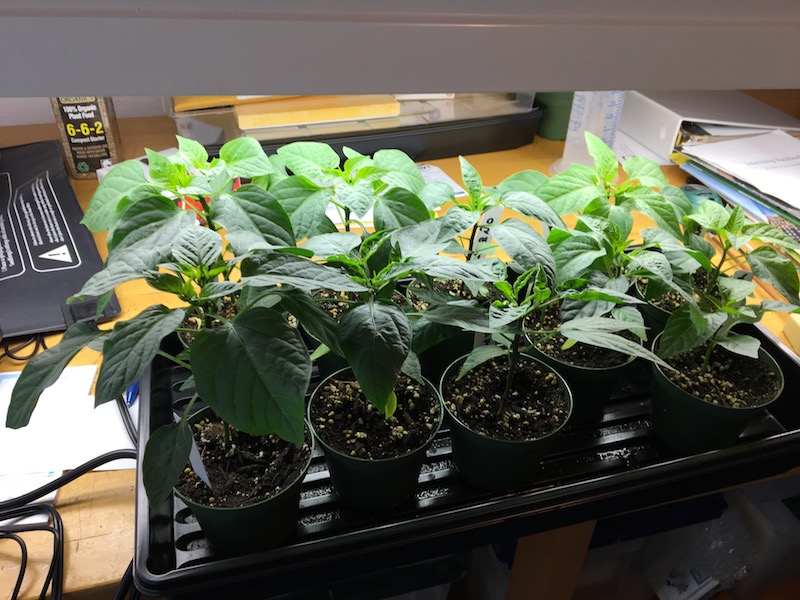
Saturday, March 3, 2018

Pepper Update 3/3

The peppers are doing quite well. Even though the plants are only about 6 inches tall some already have blossom buds on them. They seem to have liked the transplant to the 4 inch pots. Probably won't be long 'til I will have to redo them again. I will give it a couple of more weeks.


I did put some Osmocote on them. I just used a few pellets on each plant. The leaves on some of them were starting to a little yellow. The Osmocote seems to have fixed the problem. Osmocote is a pelleted fertilizer. Supposed to work for 6 months with each use. The granules or pellets dissolve slowly over time to feed the plants. It looks from the percentages of nutrients that it is 5-3-4. Probably too much nitrogen but we will see what happens. Generally flowering and fruiting plants like more potassium and phosphorus than nitrogen.

The plants look great. I am surprised by the blossoms but that's great as well. I will probably take one for a door prize at the next Master Gardener's meeting in three weeks. I think it will be well received.

Tuesday, February 27, 2018

Winter in the Garden 2018

The winter weather this year has been variable. We had the warmest December (2017) on record. At nearly the end of February we are 20 inches below average on snowfall. Of course that doesn't mean we won't hit our average for the year. So far February is about 15 inches above normal with much of it falling in the last few days. We are above average on precipitation for the year so far. Much of that has been in the form of rain rather than snow. The snowfall is from the beginning of the season (October 2017). The precipitation is from the beginning of 2018.

There is about a 20 inch blanket on the garden as I write this entry. I actually wish there had been that much since the beginning of the season. The snow is beneficial. It keeps the frost from going too deeply in the ground. Since the frost doesn't get as deep the garden soil generally stays warmer. The bacteria and fungi that breaks down the organic matter into nutrients may keep working. This may require fewer soil amendments in the spring before planting. The most obvious effect of the blanket of white is the soil will thaw faster in the spring. After thawing the soil needs to warm so the seeds will germinate more quickly. The garden will also absorb more water the sooner the ground thaws. And most important, with a nice blanket of snow we should be able to plant sooner in the spring which could mean a more plentiful harvest.

By the end of February we will have more than 10 hours and 20 minutes from sunrise to sunset. We are gaining more than 5.5 minutes each day. Spring must indeed be right around the corner. Which corner is the big question every year.


Saturday, February 24, 2018

More on pH

I would recommend that you get a professional soil test done at least once for you garden. You will get readings for pH and buffer pH. If your buffer pH is higher than 6.7 you will not be able to change your soil pH. No amount of lime will be able to raise it. You can add lime and you will get a
temporary rise in pH but the number will quickly sink back to the original. I'm not sure why but according to the Cooperative Extension Horticulturalist in Palmer, AK it's a fact. Buffer pH is something your neighborhood chemistry teacher or you test kit cannot tell you.

The buffer pH in the Harvest of Hope Memorial Garden to from 6.7 to 6.9. Since I can't raise the pH, I am very glad the water pH is 5.1 to 5.3. This will still grow everything I need to grow and I don't have to do anything to lower the pH for the potatoes. They love it. The apple trees think it's pretty cool as well.

Be sure to use a lab that is set up to test Alaska soils. There are only a few. You can check the Cooperative Extension Service website for a list. I use Brookside Laboratories in Ohio. They are the cheapest and they do the proper tests for Alaska. You should request test S001AN. The cost is $20 per sample. This will give you everything you need to get things going well.

If you have questions about this you can email me or contact the Cooperative Extension Service.

Monday, February 19, 2018

Tool Evaluation - Triple Tester

Triple Tester

I bought a tool from Amazon that was supposed to test wetness, pH, and light intensity. The tool is the XIYIXIFI 3 in 1 Soil Test Kit. It failed the wetness test. After watering with water running out the bottom of the pot, I used the tester. Now the meter goes from dry to wet with moist in the middle. One would think the tester would show wet when you test just after watering. I did make sure it was set to the right meter. It tested just barely moist. That was kind of disappointing. Well not to be deterred I tested the moisture many more times over the next couple of weeks with similar results. Boo!

So, what about the light meter? Well setting to measure light intensity I put it in direct sunlight. It measured just a tick above dark. I tested it on the lamps I use for growing seedlings. The result was the same. Double boo!

I did not test the pH meter. I didn't have a "control" to use for that test. But based on the results from the other two tests I would venture the results from the pH test would be a failure as well.

Don't buy this meter. It would be a waste of money. I haven't tested any others yet so can't make a recommendation except not to purchase this one. Hopefully my next tool test will get better results.

Thursday, February 15, 2018

Changing the pH

You may need to adjust the pH of the soil in your garden. Soils in a Alaska tend to be poor in nutrients and generally acid. Acid soil has a pH lower than 7.0. It is sometimes called "sour" soil. 7.0 is neutral, it's neither high nor low. It's not acid (low) or alkali (high).  Alkali soil is also called sweet soil. Most gardeners try to keep the pH between 6.5 and 7, so just slightly acid. It's impossible to tell the pH of your soil without testing it yourself or having someone else test it. Most green houses and garden centers will test the pH of your soil for you. You might talk with your local high school chemistry teacher to see if they would check your pH for you. You will have to get a sample or multiple samples. If you take multiple samples be sure you label them so you can keep track of the pH in specific locations.
pH, Light, Moisture Tester

You can purchase your own test kit. You will pay from a few dollars to hundreds of dollars. But if you spend more than $20 you are probably spending too much. You should be aware that many test kits have ranges on the pH scale they can accurately test. Testing ranges should be from about 4 to 8.  The tester pictured at the right has a pH test range of 3.5 - 8. I have no idea how accurate it is. At $10 even if it isn't very accurate you won't be on the hook for much money. I have ordered one of these and will let you know the accuracy and ease of use sometime after it arrives. See the tool test for triple tester. It wasn't good.

To keep things in perspective, a pH of 5.0 will still grow great vegetables and the potatoes, blue berries, and raspberries will love it. pH as high as 8 will do the same but you potatoes may look bad.  They will taste just fine but the potato scab makes them ugly. Making soils more acid is generally more difficult than making them more alkali. Instead of rewriting what other people have said about this I will provide this link for more acid and this one for more alkali. There are many other websites that will point you in the right direction just key in changing the pH of my soil on any search engine and you will get more articles that you could read in a year. If you are going to err make it on the side of acid soil.

There are certain plants that like quite acid soil (potatoes) and some that like quite alkali soil (honeysuckle). Check the seed packets, ask the representative in the garden center or greenhouse, or look it up online.

Friday, February 9, 2018

Northwest Flower and Garden Festival

I decided on Friday, February 2 to attend the Northwest Flower and Garden Festival in Seattle. I booked my tickets on Alaska Airlines using miles. I booked a hotel using the festival website. The flight down on Tuesday was uneventful, I like them like that. I walked about 20 minutes to the hotel from the Link light trail station in downtown Seattle. I highly recommend the Link from SEA to downtown Seattle. It takes about 35 minutes from the airport and if you are older than 65 the cost is $1. Even if you take a taxi from Westlake Station to your hotel it's a lot cheaper than taking a taxi from the airport and faster than the bus.

Wednesday

Slept well and had breakfast at the hotel. Breakfast was included in the price and was quite good. I walked to the convention center. It took about 20 minutes. The weather was very pleasant. High was in the low fifties. I was actually quite warm when I got to the convention center.

The first thing that struck me was the size of the vendor areas. There are literally thousands of vendors. Vendors were selling or promoting most anything you can imagine. There were two gentlemen from Edward Jones talking with people about securities. People selling jerky, caramels, honey, and jams. Others are selling windows, gutters, bricks and paving stones. Let's not forget the ones that were selling clothing and jewelry. Where ever there are women there will be those selling clothing and jewelry.  And finally there were people selling garden related things. The garden related things ranged from seeds to tools to clothing. In a few hours of walking around I don't think I saw everything that was there. Tomorrow I will do more scouting around. I could certainly spend a lot of money here if I don't show restraint.

At 11:30 I watched container wars. Two ladies competed to build containers with flowers that would look great. They both did a wonderful job. Brenda Adams was one of the contestants. She is the author of There Is a Moose in My Garden, and Cool Plants for Cold Climates. She is also from Homer, AK. Unfortunately the other lady had more support and won the competition. It was fun watching and I won a tool during the process,

Next I went to No Watering Required: Water-wise Garden Design. This was presented by Kirk R. Brown. The presentation was very interesting and informative. He is a wonderful speaker and has excellent credentials.  I am going to another of his presentations on Thursday and am really looking forward to it. I'm thinking about recommending him for a speaker for the 2019 Alaska Master Gardener Conference. I then went to a presentation on pruning flowering shrubs. It was less interesting but I certainly did learn a few things about pruning. Lastly I went to a presentation by Kerry Ann Mendez on Gardening simplified. Don't know that she really simplified anything but she is an excellent speaker and was entertaining.

Don & Kirk Brown
It was then back to the hotel for an evening of phone calls and writing. Looking forward to tomorrow and new information.

Thursday

I went to two presentations today by Kirk Brown. Both were excellent. The first was a container wars demonstration and he did a great job and won the competition. I didn't think it was really any contest. The other presentation was "A Visit from Frederick Law Olmsted". Olmsted is considered the father of American landscape architecture. The presentation was interesting and entertaining. I had no idea who Olmsted was until this presentation. I really like Kirk Brown.

I attended pieces of other talks. All of them were on flower or specialty gardens. Maybe I will be able to use the information in the future. They were of little use to my 2018 gardening plans. I also attended Cool Plants for Cold Climates by Brenda Adams. Her talk was very informative but again for my immediate future in gardening I don't think it was useful. I did enjoy it and will purchase her book by the same name as the presentation.

Tomorrow is another day. There is a spectacular Amazon building just down the street. I will probably take that in tomorrow morning.

Friday

I went to two demonstrations today. Both were on bees, pollinators. One was by Paige Embry the author of Our Native Pollinators. The other was by James Ullrich owner of Knox Cellars Mason Bees. I did purchase Embry's book and will enjoy reading it. I am considering purchasing some mason bees to put in the garden. They will not really compete with the honey bees already there. They work the plants differently and are not nearly as prolific. They should also survive the winter. I have ordered a book to read and then will make the decision. There were no other presentations I was really interested in so I left the festival at about 3:30 today.

I did go to the Amazon Understory this morning. The public can only go into the lobby. I was pretty disappointed. The habitat is only open to employees. It was designed for the employees so it seems fitting they would have access and not the public.

Amazon Understory
This pretty much wraps up the trip. I had a lot of fun. I learned a lot. I don't know if I will come back to the Northwest Flower and Garden Festival just to attend it again. If I can make it part of another trip that would be more likely.  I did come up with a couple of potential speakers for the 2019 Alaska Master Gardener Conference in Anchorage. I am looking forward to sharing some of my ideas with the committee.